Thursday, November 7, 2019

Pipelining


PIPELINING


 Pipelining is a technique used in the design of modern microprocessorsmicrocontrollers and CPUs to increase their instruction throughput (the number of instructions that can be executed in a unit of time).
The main idea is to divide (termed "split") the processing of a CPU instruction, as defined by the instruction microcode, into a series of independent steps of micro-operations (also called "microinstructions""micro-op" or "µop"), with storage at the end of each step. This allows the CPUs control logic to handle instructions at the processing rate of the slowest step, which is much faster than the time needed to process the instruction as a single step.
The term pipeline refers to the fact that each step is carrying a single microinstruction (like a drop of water), and each step is linked to another step (analogy; similar to water pipes).
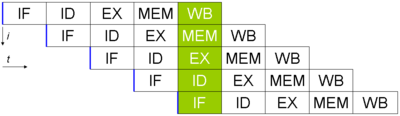


Most modern CPUs are driven by a clock. The CPU consists internally of logic and memory (flip flops). When the clock signal arrives, the flip flops store their new value then the logic requires a period of time to decode the flip flops new values. Then the next clock pulse arrives and the flip flops store another values, and so on. By breaking the logic into smaller pieces and inserting flip flops between pieces of logic, the time required by the logic (to decode values till generating valid outputs depending on these values) is reduced. In this way the clock period can be reduced.

For example, the RISC pipeline is broken into five stages with a set of flip flops between each stage as follows:
1.Instruction fetch
2.Instruction decode and register fetch
3.Execute
4.Memory access
5.Register write back

Advantages of Pipelining:


  1. If pipelining is used, the CPU Arithmetic logic unit can be designed faster, but more complex.
  2. Pipelining in theory increases performance over an un-pipelined core by a factor of the number of stages (assuming the clock frequency also increases by the same factor) and the code is ideal for pipeline execution.
  3. Pipelined CPUs generally work at a higher clock frequency than the RAM clock frequency, (as of 2008 technologies, RAMs work at a low frequencies compared to CPUs frequencies) increasing computers overall performance.

 Disadvantages of Pipelining:


  1. In pipelined processor, insertion of flip flops between modules increases the instruction latency compared to a non-pipelining processor.
  2. A non-pipelined processor will have a defined instruction throughput. The performance of a pipelined processor is much harder to predict and may vary widely for different programs.
  3. Hazards: When a programmer (or compiler) writes assembly code, they generally assume that each instruction is executed before the next instruction is being executed. When this assumption is not validated by pipelining it causes a program to behave incorrectly, the situation is known as a hazard.
    Various techniques for resolving hazards or working around such as forwarding and delaying (by inserting a stall or a wasted clock cycle) exist.

ARM PROCESSOR


ARM processor

                       An ARM processor is one of a family of CPUs based on the RISC (reduced instruction set computer) architecture developed by Advanced RISC Machines (ARM).
 
 ARM makes 32-bit and 64-bit RISC multi-core processors. RISC processors are designed to perform a smaller number of types of computer instructions so that they can operate at a higher speed, performing more millions of instructions per second (MIPS).  By stripping out unneeded instructions and optimizing pathways, RISC processors provide outstanding performance at a fraction of the power demand of CISC (complex instruction set computing) devices.

ARM processors are extensively used in consumer electronic devices such as smartphonestablets, multimedia players and other mobile devices, such as wearables. Because of their reduced instruction set, they require fewer transistors, which enables a smaller die size for the integrated circuitry (IC). The ARM processor’s smaller size, reduced complexity and lower power consumption makes them suitable for increasingly miniaturized devices.

ARM processor features include:
  • Load/store architecture.
  • An orthogonal instruction set.
  • Mostly single-cycle execution.
  • Enhanced power-saving design.
  • 64 and 32-bit execution states for scalable high performance.
  • Hardware virtualization support.                                                                                   The simplified design of ARM processors enables more efficient multi-core processing and easier coding for developers. While they don't have the same raw compute throughput as the products of x86 market leader Intel, ARM processors sometimes exceed the performance of Intel processors for applications that exist on both architectures.
    The head-to-head competition between the vendors is increasing as ARM is finding its way into full size notebooks.  Microsoft, for example, offers ARM-based versions of Surface computers. The cleaner code base of Windows RT versus x86 versions may be also partially responsible -- Windows RT is more streamlined because it doesn’t have to support a number of legacy hardwares.
    ARM is also moving into the server market,  a move that represents a large change in direction and a hedging of bets on performance-per-watt over raw compute power. AMD offers 8-core versions of ARM processors for its Opteron series of processors. ARM servers represent an important shift in server-based computing. A traditional x86-class server with 12, 16, 24 or more cores increases performance by scaling up the speed and sophistication of each processor, using brute force speed and power to handle demanding computing workloads.
    In comparison, an ARM server uses perhaps hundreds of smaller, less sophisticated, low-power processors that share processing tasks among that large number instead of just a few higher-capacity processors. This approach is sometimes referred to as “scaling out,” in contrast with the “scaling up” of x86-based servers.